

04 June 2026. Freetown, Sierra Leone. FG Gold Limited (the “Company” or “FG Gold”) is pleased to provide an update on the drilling results from the Link Zone at the Baomahun Gold Project (the “Project”). The Link Zone represents the area linking the previously established Baomahun and Pujehun deposits. The results demonstrate the potential for the Link Zone to add significant mineral resources and a new mining area on the Project. These results are part of the Company’s larger 2025-26 exploration and brownfield drilling campaign totaling over 70,000 meters – a program with the objective of identifying new gold targets and trends, as well as converting mineral resources to mineral reserves.
The Project’s high-priority Link and West Pit zones are at the northern end of a 1.5-kilometer-long zone of identified gold mineralisation that is situated between the Baomahun deposit and the Pujehun deposit (Figure 1) containing 4.5 Moz and 0.43 Moz gold mineral resource, respectively. The Link Zone is 600m in strike length and comprises multiple zones.
Highlights:
- Hole FGGDD25_209 (Link) intersected 12.0 m grading at 2.8 g/t from 38.0m, including 4.0 m grading at 5.48 g/t from 41.0 m.
- Hole FGGDD25_211 (Link) intersected 14.0 m grading at 3.6 g/t from 80.0m, including 3.0 m grading at 7.97 g/t from 84.0 m.
- Hole FGGDD25_218 (Link) intersected 17.0 m grading at 2.8 g/t from 83.0m, including 4.0 m grading at 5.0 g/t from 177.0 m.
Full results are tabulated below (Table 1) and shown in Figures 1 to 3.
Oliver Tunde Andrews, FG Gold’s Founder & Executive Chairman, remarked, “We are very pleased to announce these positive results from our drilling campaign at the Link Zone. These highly encouraging results reaffirm our exploration strategy as we continue our drilling campaign aimed at realizing and maximizing the significant upside potential of our Baomahun concession.”
“Excellent drill results and well done to the exploration team!” commented Andrew Cheatle, Head of Mining & Exploration at FG Gold. “The drilled zones represent a great exploration opportunity for the Project as it continues to test a ten-kilometer trend of demonstrated gold potential. These zones are also highly likely to extend mineralisation northwards from the West Zone, discover new parallel zones, and are a very positive first step in linking the known gold mineralisation of Pujehun and Baomahun deposits.”
Significance of Results
The intercepts confirm multiple zones of strong mineralisation northwards from the Baomahun gold deposit (4.5 Moz mineral resource, including 2.0 Moz mineral reserves), and are the first diamond drill hole intersections on the 2025/2026 Link Zone drilling campaign. The mineralised zones are in close proximity to the Baomahun West Zone and present an exploration target with potential to host significant open pit mineral resources extending to the West Zone. The location of the discovered mineralisation is attractive from an early mining perspective and could also provide a ‘near mill’ ore source, with the added advantage of possibly replacing lower grade tonnes for higher grade tonnes early in the mine plan. All zones exhibit gold mineralisation that is hosted in sheared iron – rich lithologies and are consistent with gold mineralisation observed at Baomahun. Many characteristics of the high-grade mineralization observed in the West/East/Central Zone are also present in the Link, (Figure 4).
Seth Henry Okyere, Exploration Manager, noted on receipt of the recent drilling results: “The exploration team is excited to see their effort yielding such positive drill results. This initial diamond drilling from the Link Zone validates our geological model that predicts continuity of Baomahun style mineralisation northwards toward Pujehun and beyond. These results also reinforce the Link Zone as a compelling brownfield growth opportunity capable of converting exploration success into additional mineral reserve and encourage ongoing investments in systematic drilling along the corridor”.
Ongoing Planning
The drilling program for the Project is continuing and will be expanded with the addition, in Q2, 2026, of three additional drilling rigs – bringing the total to five drill rigs at the Project site. The Company’s intention is to develop a drilling program that will allow for rapid development of the area to potentially delineate near surface mineral reserves for mining in the short term.
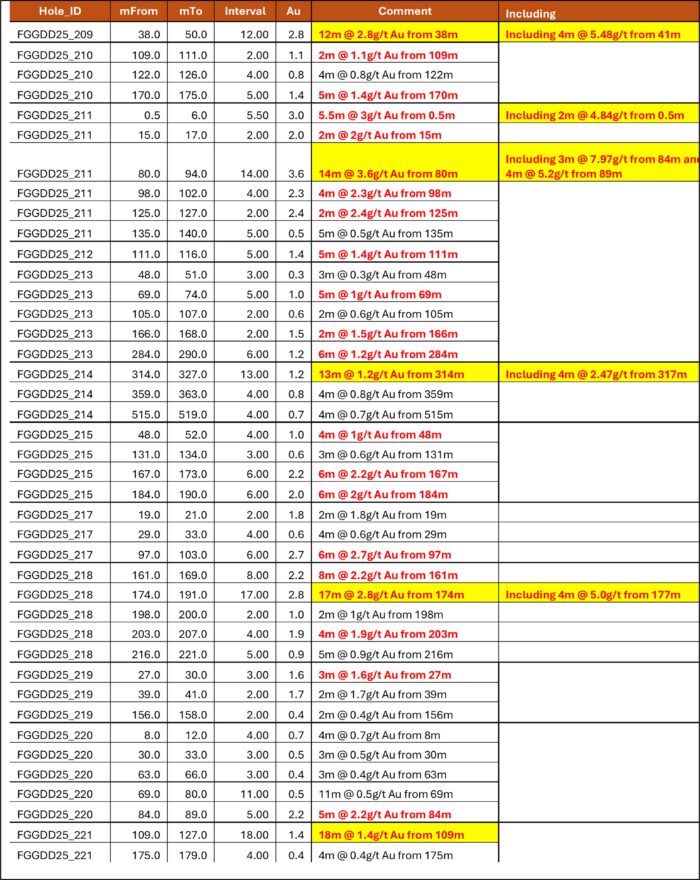
Table 1: Recent Results: Link Zone
Note: The results summarized in this release are from the Link Zone, located between the Baomahun and Pujehun deposits. Intersections reported here are a down-hole length and may not represent true width, however the true width is estimated to be between 80-90% of the down-hole length.
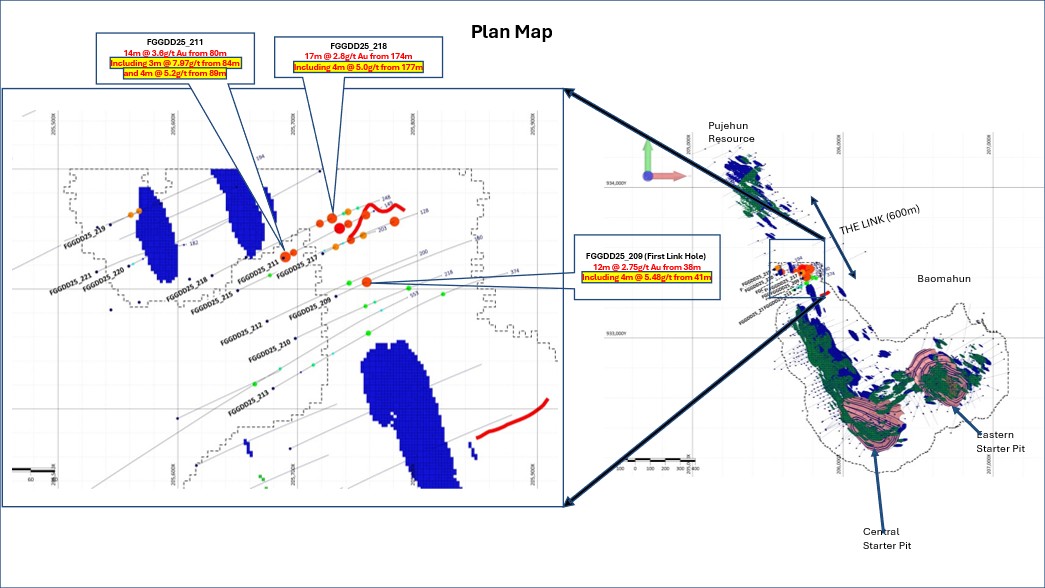
Figure 1. Map location of the Link Zone in relation to Baomahun West Zone, showing recent drilling results.
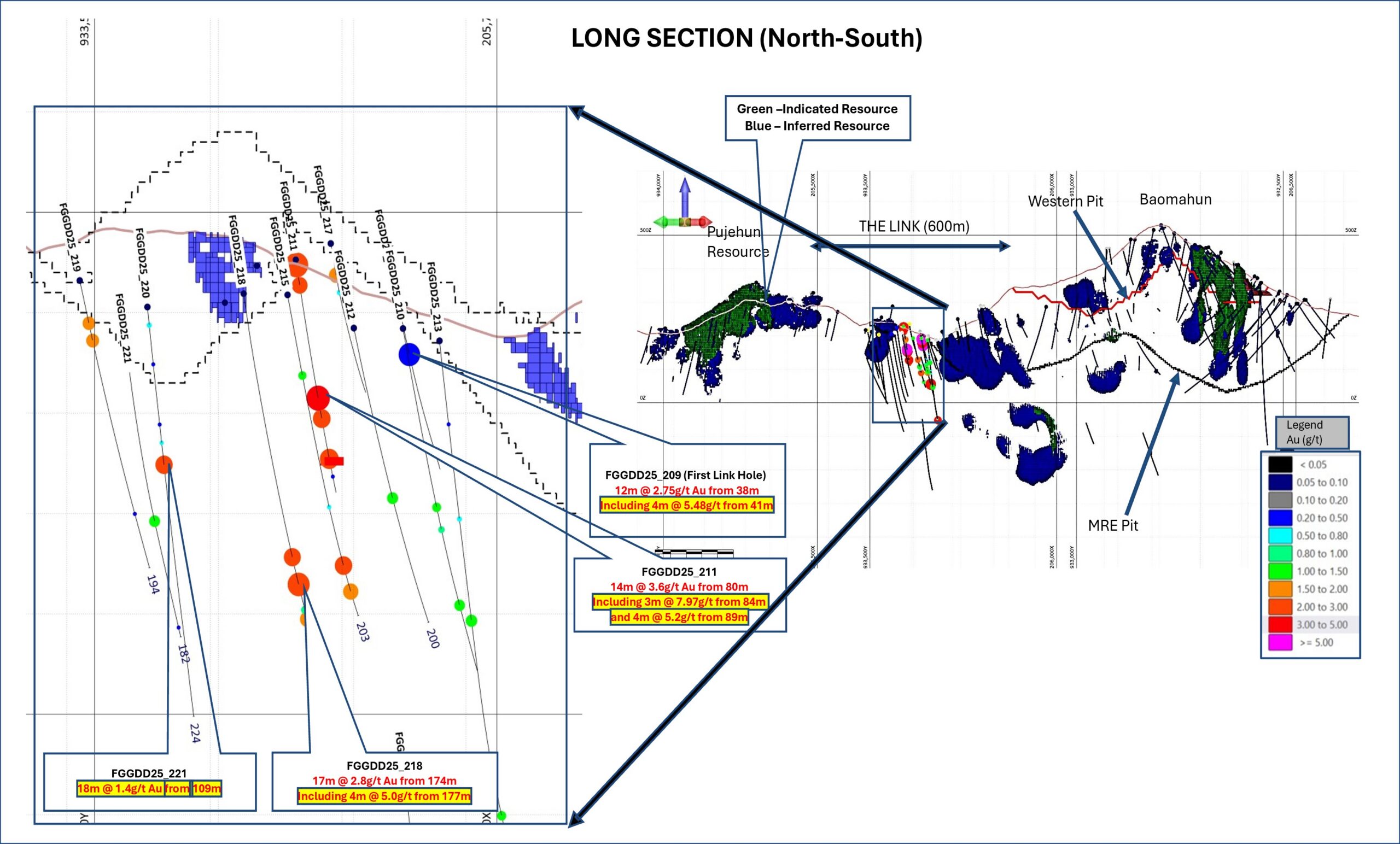
Figure 2. Long section (view east) showing location of recent results between Baomahun and Pujehun deposits
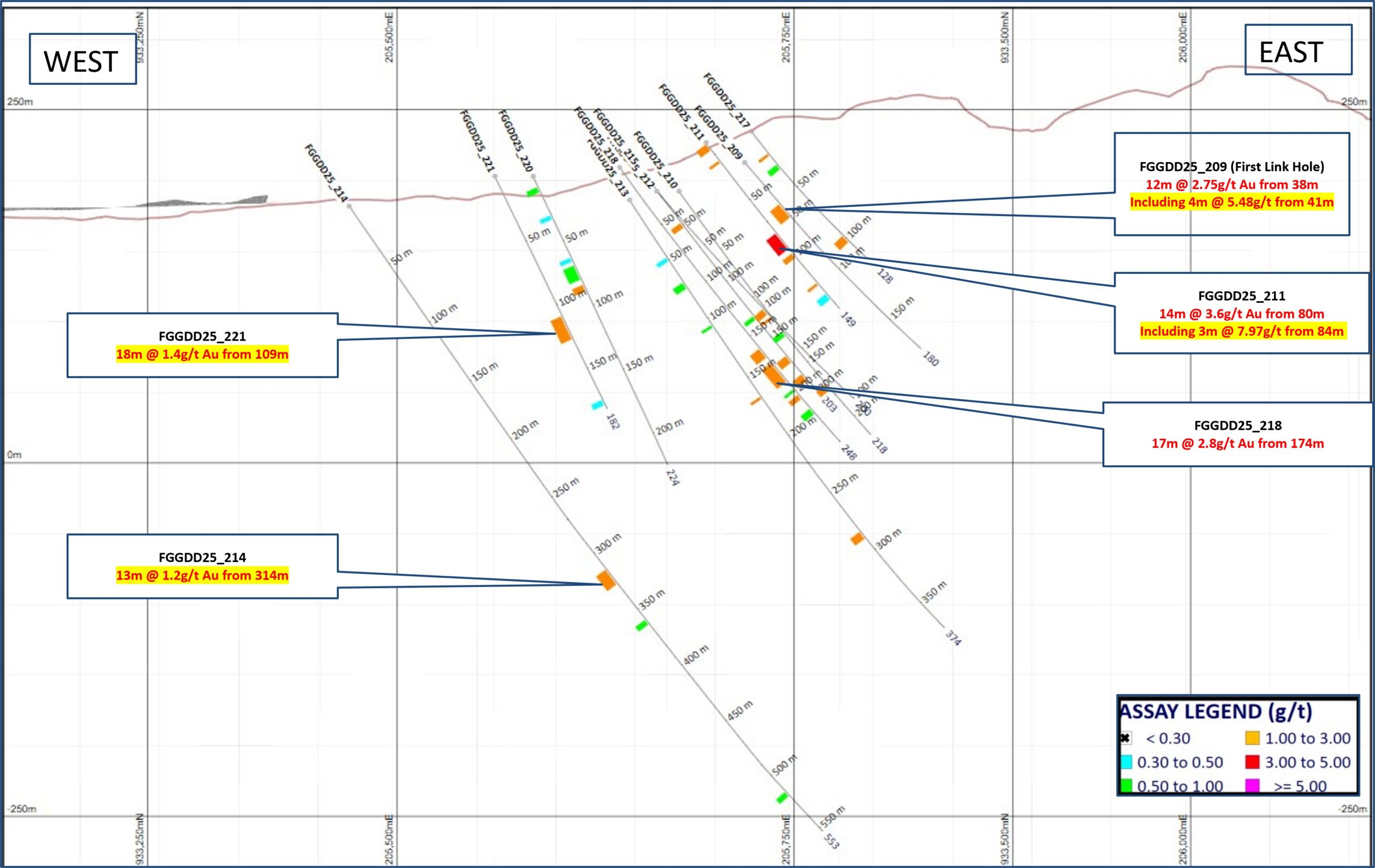
Figure 3. Cross section (view North) showing location of recent results between Baomahun and Pujehun deposits.
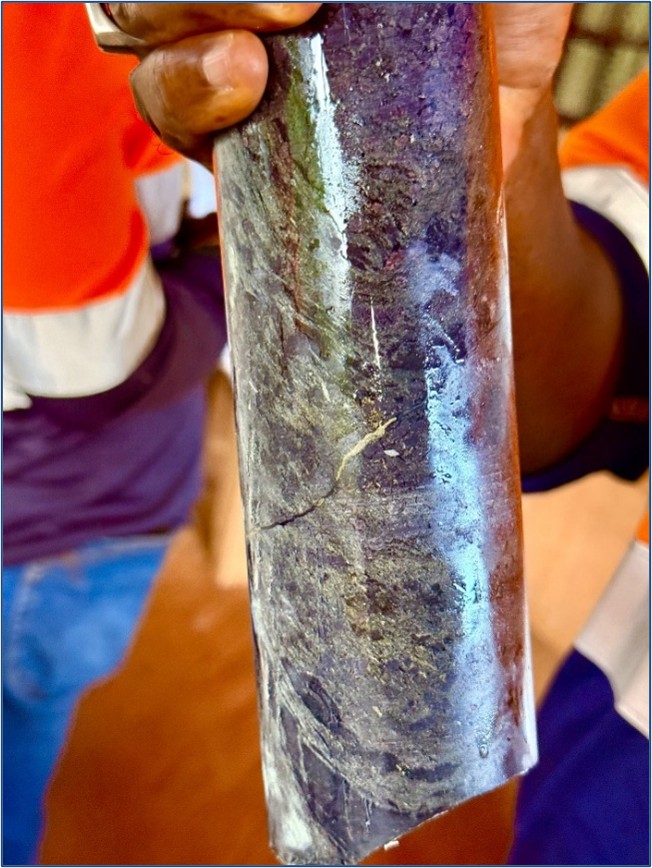
Figure 4: High grade core from DDH FGGDD25-209 located approximately 50.0 m below a surface outcrop of the mineralized zone.
Qualified Persons
Mr. Andrew Mark Cheatle (P.Geo., MBA, FGS, ARSM) and Mr. Seth Henry Okyere (MBA, MAIG, MWAIMM) are the Company’s Qualified Persons under National Instrument 43-101 “Standards of Disclosure for Mineral Projects” (“NI 43-101”) and Joint Ore Reserves Committee (“JORC”) and have reviewed and assume responsibility for the scientific and technical content in this press release.
Sample Protocol Quality Assurance / Quality Control (“QAQC”)
The sample chain of custody is managed by the Baomahun geology team on site. Reported results are from diamond drilled core samples. Intervals of core to be analyzed are split into half using a mechanized core cutter, with one half sent to the laboratory for geochemical analysis and the remaining half kept in storage for future reference and uses. Diamond drilled core has been a NQ size and recoveries are consistently 100% across all drill hole intercepts reported.
Sampling and analytical procedures are subject to a comprehensive quality assurance and quality control program. The QAQC program involves inserting duplicate samples, blanks and certified reference materials in the sample stream. Gold analyses are performed by standard fire assaying protocols using a 50-gram charge with atomic absorption (AAS) finish and a gravimetric finish performed for assays greater than 10 grams per tonne.
Sample preparation and analysis are performed by independent SGS Laboratory in Tarkwa, Ghana. SGS is ISO17025:2017 accredited and employs a Laboratory Information Management System for sample tracking, quality control and reporting.
Forward-Looking Statements
This announcement contains references to forecasts, estimates, assumptions and other forward-looking statements. Forward-looking statements are often, but not always, identified by the use of words such as “seek”, “anticipate”, “forecast”, “believe”, “plan”, “estimate”, “expect” and “intend” and statements that an event or result “may”, “will”, “should”, “could” or “might” occur or be achieved and other similar expressions. All forward-looking statements are based on information and estimates available to FG Gold at the time of this announcement and are not guarantees of future performance. They may be affected by a variety of variables and changes in underlying assumptions that are subject to risk factors associated with the nature of the business outside of FG Gold’s control, which could cause actual results to differ materially from those expressed herein. Examples of forward-looking statements (made at the date of this announcement unless otherwise indicated) include, among others, statements regarding intentions, beliefs and expectations, plans, strategies and objectives of the directors and management of FG Gold.
Any forward-looking statements, as well as any other opinions and estimates, provided in this announcement are based on assumptions, contingencies and estimates existing at the time of assessment and which are subject to change without notice impacting the accuracy of those statements and which may prove ultimately to be materially incorrect. Forward-looking statements are not statements of historical fact and actual events and results may differ materially from those contemplated by the forward-looking statements as a result of a variety of risks, uncertainties and other factors, many of which are outside the control of FG Gold. Such factors may include, among other things, risks relating to funding requirements, gold and other commodity prices, exploration, development and operating risks (including unexpected capital or operating cost increases), production risks, competition and market risks, regulatory restrictions (including environmental regulations and associated liability, changes in regulatory restrictions or regulatory policy and potential title disputes) and risks associated with general economic conditions.
The distribution of this announcement may be subject to legal or regulatory restrictions in certain jurisdictions. Any person who comes into possession of this announcement must inform themselves of and comply with any such restrictions. FG Gold undertakes no obligation to update publicly or release any revisions of forward-looking statements herein to reflect new information, event or circumstances after the date of this announcement or to reflect the occurrence of unanticipated events, except to the extent required by applicable legal or regulatory restrictions.
Media Enquiries:
Nicola Asgill
Corporate Development, Sustainability & Investor Relations Director
FG Gold
Mobile: +232 99 503 506
Email: nicola.asgill@fg-gold.com
About FG Gold Limited
FG Gold is a gold development company based focused on constructing and operating the Baomahun Gold Project located in Sierra Leone. Baomahun is one of the largest deposits under development in Africa and will become Sierra Leone’s premier large scale commercial gold mine. Upon operations, the Project is expected to deliver an average annual gold production of ~150,000 ounces per year over a 12.5-year mine life peaking at 201,000 ounces.